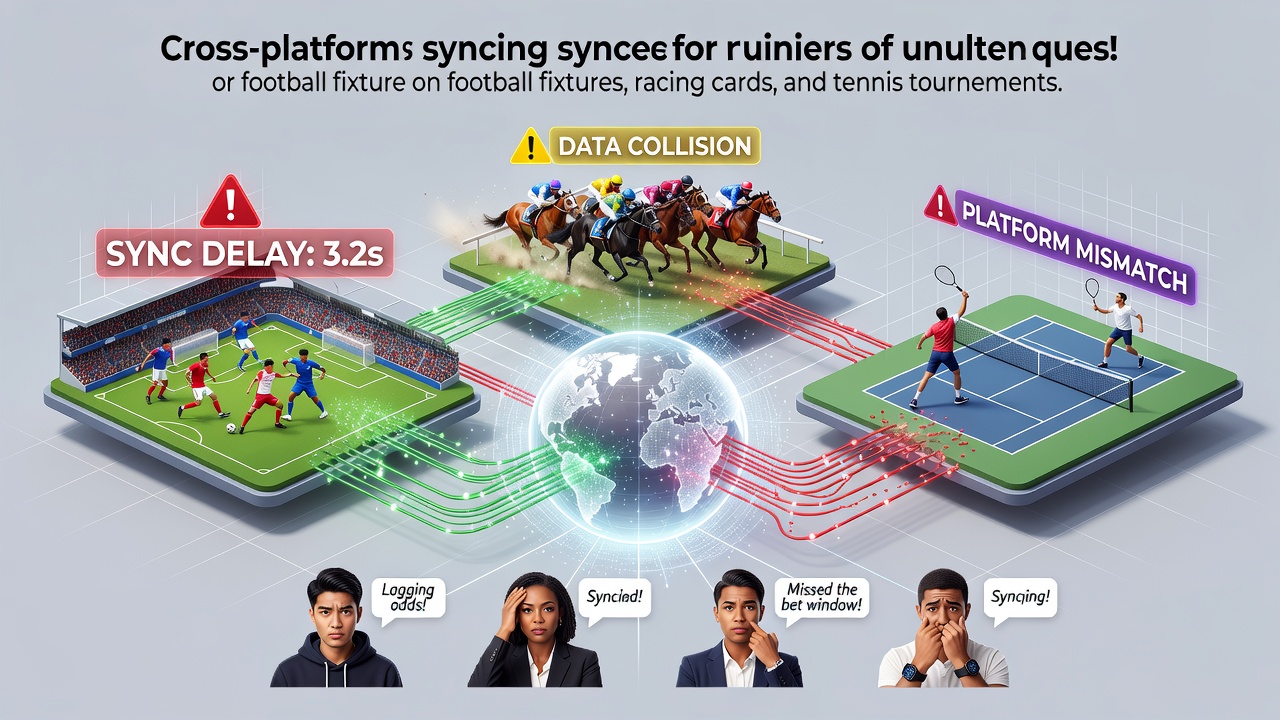
Cross-Platform Syncing Challenges for Users Placing Wagers on Simultaneous Football Fixtures, Racing Cards, and Tennis Tournaments
Users who place wagers across football fixtures, horse racing cards, and tennis tournaments often encounter synchronization issues when they operate several betting platforms at once. Data indicates that live odds, score updates, and account balances require consistent refresh rates across applications, yet differences in server infrastructure create delays that affect decision-making during overlapping events.
Technical Barriers in Multi-Platform Environments
Football matches, racing meetings, and tennis tournaments generate high volumes of real-time data that bookmakers pull from distinct feed providers, and these sources rarely align perfectly on timing or format. Observers note that when a user switches between apps to monitor a Premier League match, an Australian thoroughbred race, and an ATP tournament match in October 2026, latency gaps appear because each platform processes incoming streams independently. Research from industry reports shows that API response times can vary by several seconds, which matters when live betting windows close quickly on goal scorers or set winners.
Network conditions compound these differences, since mobile connections fluctuate while users move between locations. Studies from academic institutions have examined how packet loss on cellular networks disrupts push notifications for price changes, leaving bettors without immediate updates on one platform while another refreshes smoothly. Those managing multiple accounts must therefore refresh manually or accept that some information lags behind the actual event progression.
Account and Balance Coordination Issues
Simultaneous wagers require users to track available funds and settled positions across separate wallets, and platforms seldom provide unified dashboards. Figures from regulatory analyses reveal that withdrawal processing times and deposit confirmations operate on independent schedules, so a payout from a successful tennis accumulator might not appear in time to fund a football in-play stake on another site. People often discover that bonus terms tied to one account do not transfer when they attempt to combine promotions across operators, which limits flexibility during busy fixture periods.

Security protocols add another layer, because two-factor authentication requests arrive at different intervals and sometimes require separate device approvals. Data from technology reviews indicates that session timeouts vary between applications, forcing repeated logins that interrupt monitoring of live markets. When a horse race result posts on one platform while a tennis tie-break remains unresolved on another, users must reconcile these timelines manually to avoid placing conflicting stakes.
Data Feed Inconsistencies Across Sports
Football, horse racing, and tennis each rely on specialized data suppliers that update at different cadences, and cross-referencing these streams becomes necessary when events run concurrently. Reports compiled by international gaming associations demonstrate that score discrepancies occasionally surface between platforms because one operator receives delayed pitch-side information while another incorporates video verification earlier. In October 2026, for instance, overlapping European football fixtures with international racing festivals and late-season tennis events have highlighted how small timing variances affect accumulator calculations and cash-out values.
Users who rely on third-party comparison tools encounter additional friction when those tools aggregate data from multiple sources without accounting for platform-specific delays. Research indicates that market suspension notices and resumption alerts do not propagate uniformly, so a temporarily paused tennis game might still accept wagers on one site while another has already locked the market. This lack of uniformity requires constant cross-checking to maintain accurate positions.
Strategies Observed in Practice
Those who place wagers on multiple sports simultaneously often adopt sequential monitoring patterns, checking one application fully before moving to the next to reduce missed updates. Industry data shows that dedicated monitoring software or browser extensions can consolidate notifications, although compatibility remains limited across mobile operating systems. Regulatory bodies in various regions have documented how clearer API standards could reduce these frictions, yet adoption rates differ among operators.
Training sessions and user guides published by larger betting companies outline recommended refresh intervals and device settings that help maintain connectivity during peak hours. Observers note that combining these practices with stable Wi-Fi connections rather than mobile data tends to narrow the synchronization gaps, though complete parity across platforms has not been achieved.
Conclusion
Cross-platform syncing challenges persist because independent data pipelines, authentication systems, and update schedules operate without full interoperability. Evidence from multiple sources continues to highlight the need for improved standardization, while users adapt through careful timing and manual verification when placing wagers across football, racing, and tennis events.